They call it *“Another Sunday in Hell”*—a phrase that sounds almost poetic until you understand the suffering behind it. This is not just a race; it is an ordeal. A relentless test of endurance, resilience, and sheer willpower that has humbled champions and shattered legends. It is cycling stripped to its rawest form, where glory is earned through pain and survival is an achievement in itself.
At the heart of this phrase lies one of the most unforgiving races in the world: Paris–Roubaix. Known as *The Hell of the North*, it is a battlefield disguised as a sporting event. Riders traverse jagged cobblestone sectors that punish both body and machine, turning what should be a smooth contest into a chaotic fight for control. Dust clouds choke the air in dry conditions; in the rain, those same stones become slick traps waiting to send riders crashing.
Related posts

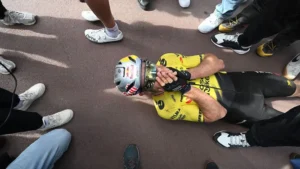
What makes this race so brutal is not just its terrain, but its unpredictability. Mechanical failures are common—tires puncture, chains snap, bikes rattle apart under the constant vibration. Even the strongest riders can see their hopes vanish in an instant, not because they lacked strength, but because luck abandoned them. In most races, strategy and fitness dominate. Here, survival and fortune play equal roles.
The nickname *“Another Sunday in Hell”* captures the psychological toll as much as the physical one. Riders know what awaits them: the bone-rattling sectors, the inevitable crashes, the exhaustion that creeps in long before the finish line. Yet they return year after year, drawn by the prestige of conquering something so merciless. Winning here is different. It is not just victory—it is validation.
Legends of the sport have both triumphed and failed on these roads. Greats arrive in peak condition, only to be undone by a poorly timed puncture or a momentary lapse in concentration. Others, less favored, rise through the chaos to claim immortal glory. Paris–Roubaix does not always reward the strongest; it rewards the toughest.
And that is why it endures. In an era of precision training, advanced technology, and calculated racing, this event remains gloriously primitive. It resists control. It defies prediction. It reminds the world that sport, at its core, is not always fair—and that is exactly what makes it compelling.
“Another Sunday in Hell” is more than a phrase. It is a warning, a badge of honor, and a testament to human endurance. For those who ride it, it is suffering. For those who win it, it is immortality.